Where a 230V LED strip makes the difference
- Facades and roof edges: one crisp contour line that makes a shop, restaurant or business building stand out at night.
- Canopies, carports and shelters: light from above over the full length, protected from direct rain.
- Warehouses, greenhouses and workshops: long lines of light in damp commercial spaces, without power supplies along the way.
- Terraces and balconies: a warm line along the edge for atmosphere late into the evening.
When do you choose a 230V LED strip?
For long runs: up to 50 meters on a single plug, without extra power supplies and without the voltage drop of 12V or 24V. Need more? The strips can be extended with couplers. Thanks to the IP65 coating they are suitable for damp spaces and outdoors under a roof. For short runs indoors, cabinets and furniture, choose a 24V LED strip with a power supply: it is thinner, can be cut more finely and is safe to touch.
Which 230V LED strip do you choose?
- Basic, 60 LEDs per meter: 4 W/m and about 400 lumens per meter. For ambient and contour lighting.
- Pro, 120 LEDs per meter: 4.8 W/m and about 480 lumens per meter. More even light, the most popular version.
- Ultra, 180 LEDs per meter: 7.2 W/m and about 720 lumens per meter, 12 mm wide. For functional lighting.
- COB 230V: 10 W/m and about 1,000 lumens per meter, one even line of light without dots.
- RGB 230V: 12 W/m for long lines of color, operated with a 230V RGB controller.
All white versions are available in 3000K warm white, 4000K neutral white and 6000K cool white.
Connecting and installing
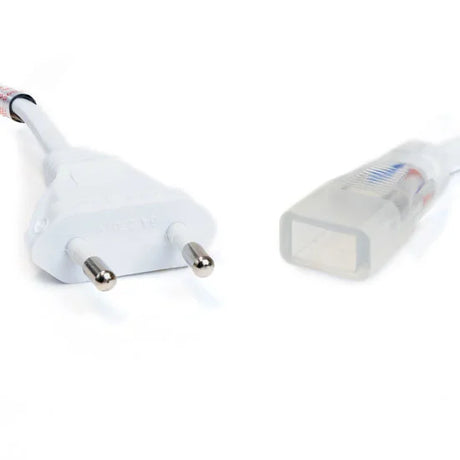
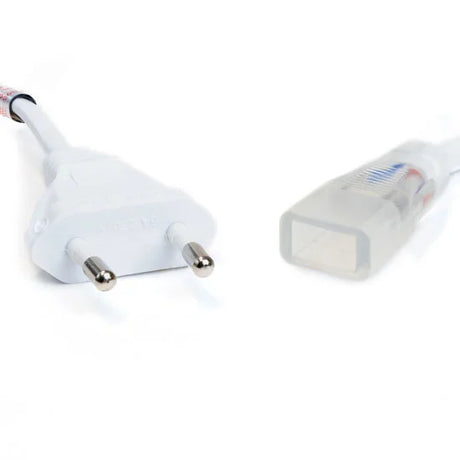
A 230V strip is connected with the matching plug: 6 mm for Basic and Pro, 12 mm for Ultra. Couplers let you make joints, corners and extensions, and end caps seal the strip watertight. See the LED strip connectors.
- Basic, Pro and Ultra are cut per meter at the marked cut points. Seal every cut end with an end cap.
- 230V is mains voltage. Have the fixed connection made by a qualified electrician and use a circuit with an RCD in damp and outdoor locations.
- Outdoors, mount the strip under a roof or in a profile: IP65 protects against splashing water and rain, not against immersion.
Frequently asked questions about 230V LED strips
Is there a difference between 220V and 230V?
No. Mains voltage in Europe is officially 230V; 220V is the old name. A 220V LED strip works on any standard European socket.
Do I need a transformer or power supply?
No. You connect the strip straight to the mains with the matching plug.
How long can a 230V LED strip be?
Up to 50 meters on a single plug. With couplers you join several lengths or make corners.
Can I shorten a 230V LED strip?
Yes, per meter at the marked cut points. Seal the cut end with an end cap so the strip stays watertight.
Is a 230V LED strip dimmable?
Yes, with a suitable 230V strip dimmer. A standard wall dimmer usually does not work. Not sure about the combination? Contact us and we will advise you.
Can a 230V LED strip be used outdoors?
Yes, under a roof or in a profile. See also the outdoor LED strips and the waterproof LED strips.
Do you supply larger quantities of reels?
Yes. Volume pricing applies to larger quantities, and for projects we prepare a custom quote.